As long as I can remember I have been reading books. My mother used to have a large library of books, in a solid oak book case along the living room wall. All books were behind glass. The books I read when I was only 9 years old where history adult books. There was always a fascination for history and the lure of the international world, strange and far away cultures and countries. Notwithstanding the quote hanging on my wall (pressed in wood): “On apprend plus dans les Bois que dans les Livres.” (you learn more from nature than from books), I have to admit that there is a lot to learn from books. I may even go as far as to say: “all good people have libraries in their homes and they read”. For me a home is not a home without walls of book cases filled with books. We are not talking about paper backs, or the odd books one takes out at the local library. I am blessed to live near the Central Public Library in Victoria, BC. Despite my many own books, accumulated in many languages throughout my life, I am an avid borrower of the books in our library. They come in many languages and are among the best classic and newly published editions one can imagine. The way I see it, “when choosing a book to read, I am expecting to learn from it”. Bad language won't do at all. A book has to be intelligent, imaginative, informative and interesting enough that you do not put it down. When I was still in Europe, I belonged to a good Buchgemeinschaft, acquiring the latest in science, religion, sociology, psychology, philosophy, history, and politics. Later adding travel books. And an entire library in itself on horses, the American West and the history of the North American Natives. During the time of post-war WWII there was a lot going around with communist activities and actions. We picked up tracts at the largest universities – those are all pamphlet books which are neither for sale, nor on loan at any library. Of the classic writers, my favorites are the Russian authors. It is always said, that any private collection should include those three books: Le Petit Prince (Antoine de Saint-Exupery), Karl Marx: Das Kapital; and the Bible (which I do not have, but instead “The Bible in History”). Do I want to get rid of my books, because some acquaintances are telling me so ? No. I always get suspicious if someone telling me “why don't you get rid of your books ?” Doesn't that remind you of certain evil people in history, who were burning books ??? In my international travels, be it in Europe or anywhere in North America, I always – when renting an accomodation somewhere to stay – will choose a location near a library. And get myself a library card. Of all plastic cards, a library card is the important one. Be it Grande Bibliothèque Montreal, QU, Bibliotheque de Quebec, R. Saint-Joseph Quebec City, Konstanz Germany, or even the most beautiful of them all The Library of Congress in Washington DC, where I also got myself a library card. For me it is easy to do so, if not for the very reason of having completed my Master of Science in Library Science at the University of Syracuse, New York. So, whoever is suggesting “to get rid of my books”, I am telling them “this is Adolf Hitlerism”. Talking about 'book burnings': Thousands have taken place from Antiquity throughout the centuries [ http://en.wikipedia.org/wiki/List_of_book-burning_incidents ]. Yet, I cannot imagine one intelligent person who does not enjoy reading a good book. When it comes to books, I prefer the written on paper kind, not your Amazon/Kindle Fir hand held e-books type. Where books also come in handy: Languages, learning and maintaining one's own mother language. Just as travel opens your mind, so does a good book.
Category: LIFE STORIES
Libraries & the Wonderful World of Books
Trains and Train Stations
I love trains and train travel. Here in Canada we have the big trans-Canadians, the likes of VIA Rail (for passenger traffic), CN Rail (commercial) and the special more touristy (but very elegant and expensive) train companies (like the Rocky Mountaineer). Being on Vancouver Island on the Pacific Coast unfortunately we lost our last Island train service a while ago, but in the process to re-establish a new VIA RAIL route from Victoria to Courtney, North Island.
When in Europe (or for that matter elsewhere, wherever I can find trains service) I always take the train. It is sort of an addiction. In Europe with those millions of passengers it is a very fast sort of exercise, run down, run up, run to the platforms, hopefully find quickly where the waggon is in which I had reserved a seat. My advice: Always reserve a seat in advance; and try to get special rates or tickets in the country you travel. Do not buy your expensive rail passes in North America. I always found somebody kind enough to help with suitcases in case the station has no elevator. When I grew up in Europe we travelled a lot by train (and of course there were also those wonderful city trams, now mostly replaced by buses). In the 1960s I had to take the train from Munich all the way to Zagreb, at that time it was still Yugoslavia. [ NOTE. After World War II Zagreb stayed the capital city of the Socialist Republic of Croatia within Yugoslavia. ]. The Soviet presence felt everywhere. [ NOTE. The introduction of the railroad to Zagreb in the 19th century was a key factor in the development of Zagreb, as was the addition of Zagreb to the Oriental Express schedule. ]. One of the longest train rides I ever made during that period. Days, no seats, I had to sit on my suit case at one end of ,a waggon. Munich, Bavaria through Austria, Czech, Roumania, then Yugoslavia. Soviet presence at all of the train stations where the train stopped. Today the trip can be done overnight. Not during those days with the older regional trains. Comes to mind the real old traditional local trains out of London, UK, during the end of the 1950s, seats in plush velvet.
I put together several slide shows of train stations and trains for the period from 2001 until 2012. One of the most impressive trains today is the ICE 3, Germany’s DB high-speed trains. [ http://www.railfaneurope.net/ice/ice3.html ] . VIA RAIL passenger service across Canada, little tip: put on some warm clothes and socks. The train between Montreal and Quebec has strong air conditioning, quite cold. One of the most beautiful train stations is the Gare Du Palais of Quebec Ville, Quebec, Canada. A veritable castle.
Marrakech, Ville de Roses – Morocco
LA VILLE ROUGE et LA VILLE des ROSES. THE PINK CITY by the Atlas Mountains, Maghreb. Predominant flower is the rose. All buildings painted pink. A world class city of over a million inhabitants, dating from the year 1062, it is bustling with life day and night. Colours, flowers, roses, people and traffic – cars, donkey carts, everything. Marrakesh, or Marrakech (Berber: ⵎⵕⵕⴰⴽⵛ; Arabic: مراكش, Murrākuš) . It is mind boggling how much life is here. A treasure trove of culture with its old mosques, gardens, parks and palaces. It also has the largest open market square in the Maghreb, the Djemaa-el-Fna. [Jamaa el Fna (Arabic: ساحة جامع الفناء jâmiʻ al-fanâʼ]. And its large number of Riads – court yard mansions in its bustling Medina – walled old city with Souks and market squares. The Riads, some dating back to the 11th century, were originally family homes, now converted to guesthouses, cafes or private spas. Traffic here is incredible, watch out.
In March 2012 I spent one month in Marrakesh, in the 4-star hotel Dellarosa, Rue Moulay el Hassan. Unfortunately, seven days into my visit I had a bad accident, I stumbled in the street and fell hard onto the beautiful pink stone sidewalk, thereby among others twisting my foot and fracture my left foot. My plans had been, to take the train for a day trip to Casablanca, and also Fez. During that first week I only made it by bus to Essaouria, the Atlantic Coast.
I got treated in the Polyclinique du Sud, Centre de Radiologie du Sud, Rue Ibn Aicha, Gueliz, my best choice for professional medical treatment. After X-rays, I was treated by an Orthopaedic Surgeon, who taped up my foot. Nothing else could be done at this point. With taxi trips back and forth, I also got a set of crutches, and I had wheel chair service. How lucky I was, not to have broken my hip. Well, there was my one month, spending three weeks inside the Hotel (DellaRosa). I managed to take a taxi cab twice at least for a visit to the famous Jardin Majorelles (Yves Saint Laurent’s creation), and the Palais Bahia. And shorten my journeys, to quickly fly back to Canada for treatment of a big blood clot in my leg, result of that fracture.
There are fantastic train connections to all the larger cities, for example Casablanca only costs €20 return from Marrakesh. Images of Marrakech (follows my previous post) also showing a Tajine I made here in Canada [A tajine or tagine(Arabic: طاجين tajin from the Persian: تابه tabe[1]) is a historically Berber[2] dish from North Africa that is named after the special earthenware pot in which it is cooked ]. And I made Moroccan friends, so easy to get along with.
WOMEN in CONSTRUCTION
Recently published on my other blog http://renataveritasopinion.wordpress.com/2013/10/05/women-in-construction/ my experiences in all sorts and aspects of construction, renovation, fixing, repairing and similar building projects. I need to add this: I was whining too much about my experiences with the male construction population, but have to emphasize: In all those years in Alberta, Canada, I have personally met many women, hard working women, who were doing the work of men. Mostly ranch and also construction. I also am pleased to see so many posts and videos and blogs and websites of women who do construction work – from simple to hard. I am proud to meet those women. Only I never met a woman who is my age and still doing it.
Cougars on Vancouver Island
The American cougar (or mountain lion, puma, or mountain cat) is a fairly large cat, weight of a male up to 100kg, a female up to 60kg. This animal’s range is rather large, from North America, Canada West down to Mexico and the most southern ranges of South America. Making it one of the smartest predatory big cats, who are not on the brink of extinction. They can live in cold, snow, and in hot climates. Mostly prefer rocky areas, where they can hide and stalk while the prey is roaming on a lower plain.
Attacks encountered and witnessed when in Alberta, Kananaskis Country West of Calgary. We went riding in the Foothills. And a cougar does what it does best, ambush and jump from the top of a rock or cliff. Jumped on the horse, that of course bolted away in terror, threw the lady rider (lucky she was) and seriously injured that horse. I saw it, its skin was shredded. I did a lot of solo riding (twenty seven years) in the Foothills of Alberta. Always look up in addition to look ahead and down for signs of cougar or grizzly bear. On my 80-acre ranch in the Alberta Rockies I had cougars on my land. Maybe I had been lucky. Went around them, when finding a deer kill site. Retreat and get out of there.
Why many cougars on Vancouver Island ? Because it is an island, because it is rocky (volcanic rock), high rocks. I love these cats. But also realize they can be close anywhere where I cycle on the trails outside the city. Usually the cougar does not attack a person, but can and may when opportunity knocks or because of inexperience (especially young cougars), or when confronted. Vancouver Island cougars are a bit different. Less area, more conflict with people, and they cannot leave this island ? Not quite true – a cougar can swim [ http://o.canada.com/2013/07/24/swimming-cougar-vancouver-island/ ].
More than two thirds of North American fatalities occurred on Vancouver Island. Incidences here include: young cougars wandering into the Victoria Empress Hotel (tourists terrified – animals terrified). One lady told me she went swimming in the surrounding ocean, on her return to the beach, that big yellow cat was there looking at her. There is lots of deer (the cougars’ staple prey), but sometimes they take pets, and they can be dangerous to children.
When walking alone in the wilderness, chances of running into a cougar are real, pointless to run. This will trigger their stalk-and-hunt instinct. Somebody told me, take a long stick with you, makes you look taller. Doubtless I could stand up to an attack. Usually, cougars are shy and keep away from humans, but also are not easily scared away by humans. The latest most recent attack off Northern Vancouver Island, bizarre and unique, because the animal got killed. [ http://www.theglobeandmail.com/news/british-columbia/woman-critically-injured-after-cougar-attack-in-clayoquot-sound/article14188088/ ]
Yet, statistically speaking cougar attacks are rare compared with human against human attacks. Those lovely big tawny cats are just fighting back for lost territory and loss of prey species.
[Any commercial ads/video’s following this post originate solely from the Word Press organization. I distance myself from any such advertised products. The Editor.”]
Browning – the gun that followed me around the world
This (now vintage) Browning 7.65mm handgun, owned by my (then) husband, does not exist anymore. Of course not. In Canada we have a strict gun control system, which after years of investing large amounts of government funds into the registration of all guns, including long rifles, finally relented on the hunting rifles category. Following lots of opposition. In Alberta for example, we go hunting for meat each winter during hunting season. I myself having spent 27 years in Alberta in the Foothills of the Rockies, did go hunting in winter. [More on this – all of which was legal during the season – in another post.]
The story of the handgun, however, is a different one. Its ‘journey’ around the world started in The Netherlands. In the approx. 1960s. The little handgun, a Browning caliber 7.65mm European model, here the .32 ACP [ http://en.wikipedia.org/wiki/.32_ACP ] belonged to my husband * who spent years in the Indonesian war theatre Koninklijke Marines Java/Indonesia long before I met him in the Netherlands. In fact, I got him with the handgun, 1967. Tough luck for me ! Because that gun was in the house. [NOTE. Don’t get uptight about that gun, because it is long gone – 1980s.] This here is the story about that blasted handgun which had followed me around the world.
I had left Holland in 1973. Personal and family circumstances. To start a one-year contract with UNESCO, BIE in Geneva, Switzerland. Also circumstantial is the fact that this gun could not be left behind in our house in Holland.** [Again not part of this story.]. So, I packed it up in my car when leaving The Netherlands in a very good location. During that time there was no European Union and open borders. There were strict border controls. I had to first travel to France, Paris, UNESCO HQ for a one-week introduction course. I got across that border. Then from Paris driving to Switzerland, to cross that border. My car was checked very thoroughly. But I got through. Nerve wrecking. In late 1974 returning from Geneva to my home town to leave my personal belongings with family. From there leaving Europe and to the United States, to start my graduate program at Syracuse University.
After my graduation from Syracuse University beginning of 1976, we decided to stay in North America and went up north to Canada. [My little son was with me all the time.] Well, eventually I got the Landed Immigrant visa for Canada and also a full time job here. My personal stuff was still with family in Europe, including that ‘blasted’ handgun. After couple of years in Canada I requested my books and other stuff to be sent over, which is possible when first arriving here as Landed Immigrant.
Opening up the big crate with all sorts of value less junk (which had cost me a fortune for shipping and was not worth it), what do I see ? The Browning handgun. Canada Customs had not checked nothing. Scary stuff ! How can I go to any authorities and turn this in ? This ain’t even my own gun. *
Using that stupid thing for target shooting behind the house in the country. Until somebody turned me in to the (ha, ha) RCMP. So, for my then long dead husband*, he passed away in Holland 1974, I was charged with illegal possession of a handgun. Went to court, in that little town, all those Natives staring at me (ANNIE GET YOUR GUN). I got unconditional discharge. RCMP took the gun. Where it is now, I do not care. What I learned from this story: Never take into custody anything like that because the gun’s owner being unstable and could not be trusted with such, just to have done him a favor. **
Smoking in the Work Place – TCPL Resources
Smoking in the work place 24/7. What does the World Health Organization say about this ?
“As a matter of social justice, human suffering related to work is unacceptable. Moreover, appreciable financial losses result from the burden of occupational and work related diseases on national health and social security systems, as well as from their negative influence on production and quality of products. All these adverse consequences, which are economically costly to employers and to society, are preventable through measures which have been known for a long time, and which are often of low cost.”
During the 1980s heavy smoking had still been allowed in the work place, despite of the fact that inside the high-rise downtown Calgary buildings (oil companies mostly) Warnings were posted inside the elevators: SMOKING IS NOT ALLOWED. Think about it.
What does it feel like to work daily in such an environment: You arrive at 8 am in the morning at your workplace, either office space, or as in the Computer & Data Processing departments more often than not ‘cubicles’, meaning low partitions and one large area shared by many. Then once many smokers have lighted up, as a non-smoker you start inhaling the deadly fumes.
Within a few hours you start trembling and feeling like your body really wants it, but your brain does not. That is what we call ‘secondary smoke inhalation addiction’. What follows: chronic allergies, respiratory problems. I had my first sinus surgery in 1983 following extensive tests to all sorts of allergens, TOBACCO bringing out the worst reactions.
Bottom-line: At TCPL (Trans Canada Pipelines) Resources I made a few comments on this, the situation was well known to the company. Eventually during the oil industry downturn following the years 1985 I got laid off with a Micky mouse severance pay of $14,000 (after 7 years in the Calgary oil industry, no pension), while the heaviest smokers on my IS project team stayed. As per TCPL Resources, this process can be referred to as their own little version of “social justice”.
[s.a. http://renataveritasopinion.wordpress.com/2013/07/03/tcpl-resources-trans-canada-a-history/ ; http://renataveritasopinion.wordpress.com/2013/06/15/secondhand-smoke-tcpl-resources-ltd/ ; https://renataveritashistory.com/2013/07/03/trans-canada-pipelines-tcpl-resources/ ;
SMOKING CAN KILL – the Lung Association British Columbia : [http://www.bc.lung.ca/ ] [ http://www.ilo.org/safework_bookshelf/english?content&nd=857170157
TRAVEL SOLO AS A WOMAN
Second instalment to my first blog on WOMEN TRAVELLING SOLO. https://renataveritashistory.com/2013/03/04/female-solo-travel/
Food for Thought: In the 19th and into the 20th century, a woman traveling alone would be considered having questionable morals. Today – the opposite, a single woman traveling with men may be looked upon as having questionable morals, unless they are family or friends.
I STRONGLY BELIEVE IN TRAVEL & LEARN.
Tips on how to handle situations in which country, and which countries are safe, which ones to be more careful in:
Central Europe – no problem, all Western continental countries including the U.K. pretty safe. Always useful to speak several languages, to get services at more decent prices. Taxis maybe a different thing. Since I mostly use the train to get me through most countries comfortably, there is no need to worry about being ripped off. Often, the big national train services have temporary specials on to buy low-price tickets. Most trains in most of those countries are also fitted now to handle physically handicapped persons. Overnight trains – traveling alone – I would be more careful.
Once you leave the main European continent, to travel to Africa, North Africa, just be more alert. The Maghreb countries – I did not find difficult at all. Taxi drivers tend to want to drive you around, even if you specify a fixed location. If you speak French (or Arabic) tell them you are already a guest in their country for weeks, no need to see this and that, “just get me to my destination”. Often cab fares are negotiable, as well.
My life was at stake only couple of times, when I was young, hitch hiking – even in my own country then.
In all those many years living, working and travelling in all sorts of countries, I only really were attacked once physically – in Rotterdam NL. But that was late in the evening. My own fault. [NOTE. I can only comment here on North America, Central America, Europe, Eastern (Soviet) Block countries (then), St. Petersbourg (recently), Scandinavia.] All went well.
In general I must say, that I am safer now when traveling alone, compared to when I was young.
HAPPY TRAVELING ! [post created with Firefox v.19]
SECONDHAND SMOKE – workplace Alberta oil companies
Innocent bystanders swallowing poisonous smoke from smokers. Basically, I don’t care if anybody smokes or how much they smoke, the more the better.What I as non-smoker care about is, though, to be forced to inhale that poison that others blow out. In other words: Swallow it. So, that I can continue to live.
A horror story follows: While working in Alberta’s oil industry from 1977 until the beginning of the 1990s, I was exposed in the workplace, in the offices, to second hand smoke. Myself I do not smoke, but many employees – particularly in the computer systems departments – did. This kind of (socially irresponsible) behavior lacking any controls or policies for protecting their employees resulted during those years in sickness, diseases of the lung and respiratory diseases. This to employees who were innocent bystanders, so to speak. Not only did our clothing get burned by employees walking around the workplace, burning cigarette in hand, but also during the last few years in the beginning of the 1980s while employed with TCPL Resources [ http://www.transcanada.com/splash/ ] this situation defied all descriptions. Arriving before 8 am for work, by 12 noon the air in the offices and corridors could be cut with a knife. Worse, because we in the computer department were sharing the air freely while working in open cubicles.
TCPL Resources took over our company Maligne Resources (a division of Dow Chemical) in 1983 . By fall I needed my first sinus surgery. Since the atmosphere inside TCPL Resources was such that we were not allowed to take out extended sick leave, I needed to go back to work soon after the surgery. My days were horror! My bleeding throat was almost choking me, while at the same time choking on others’ cigarette smoke. Of course, I commented on this situation, especially since already in all elevators in those Calgary, Alberta, high rise offices were notices posted on NO SMOKING. Result: By 1986, the new management (sent down from Toronto) started laying employees off in droves. First to go were those (complaining about the smoking) and single mothers – like myself. The heavy smokers were kept.
1986 was a bad year for finding any employment as a female systems professional (single mother with child). Those bastards ! Not only did I loose my (almost vested) company pension benefits, but had to leave behind my home in Alberta and my son go East (Ontario) and finally launch a job as a Systems (self-employed) contractor.
Years later, I found listed among others in relevant sources on companies and their social responsibility status, TCPL Resources (this arm may not exist anymore). Makes me really sick, when companies deliberately ‘kill’ their employees, than apply dirty business practices for layoff, then appear – newly born and re-invented – as socially responsible!
SMOKING CAN KILL – the Lung Association British Columbia : [ http://www.bc.lung.ca/ ] [ http://www.ilo.org/safework_bookshelf/english?content&nd=857170157
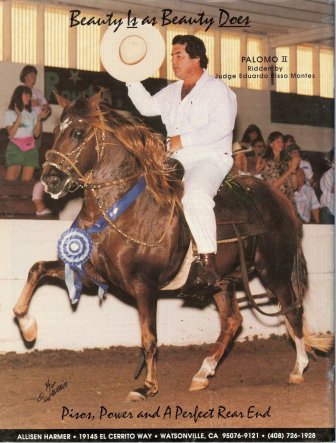
PERUVIAN PASO HORSE WITH FOAL
The Peruvian Paso or Peruvian Horse is a breed of light pleasure saddle horse known for its smooth ride. It is distinguished by a natural, four-beat, lateral gait called the paso llano. This breed is protected by the Peruvian government through Decree number 25919 of Peru enacted on November 28, 1992, and has been declared a Cultural Heritage of the Nation by the National Institute of Culture (INC).[1] Due to the isolation suffered for about 400 years and the selection made by their breeders, this breed is very particular in their body proportions and a side walk or “paso llano” that is characteristic. It is typical of the northern Peruvian regions of the country from which he originated [Wikipedia].
In 1998 I had acquired a registered Peruvian Paso mare called SIRENITA. Señorita Sirenita was a lovely little dark bay mare, small even for her breed who are smaller horses, very elegant with a nice smooth Paso Llano gait (a distinct inherited, andcompletely natural four beat lateral gait ), eager to please and with Brio (qualities of boldness, exuberance and astute focus in service to the rider). One says, “riding a Peruvian Paso with a glass of Champaign in one’s hand should not spill a drop of it.”
Sirenita when I bought her had been 4 years young only. Trained by a professional Peruvian trainer at the Ranch where she was foaled. I brought her to my Ranch in Alberta NW of Calgary in the Foothills of the Rockies, together with a companion mare, to keep her company. I rode Sirenita her in the forests (my 80-acre Ranch was surrounded by miles of Crown Land, lots of space) and the trails. She was easy to get along. 1999 we had her bred by one of the class stallions at her home Ranch, RDLF DON RODOLFO, also a dark bay stallion, bred as so many Peruvian Pasos in California Rancho de la Florecita.
It is difficult to trace Peruvian Paso’s bloodlines as there have been in the past little recordings. Good sources for more information are http://www.napha.net/DatabaseAppCode/NaphaWebSite/NAPHA.aspx?&height=800 , and http://www.peruvian-pasos.com/horses.html .
Before Sirenita was due with a foal, I had brought the two mares to her home Ranch because with their hundred or so Peruvian Pasos they had the better foaling facilities. My beautiful little SIRENITA had a tiny little foal exactly on Mother’s Day, May 14, in the year 2000. And the other little miracle was that the foal – who was a colt – turned out to be sorrel in color, a beautiful golden bronze color, unlike his parents, who had both been dark in color.
That’s where the real story starts, with training a horse baby. After the night the baby was born I drove down to their ranch, sat in their stall – it was quite an emotional experience for me. I had horses for so many years, but never a foal. He was so little (her first) that he disappeared under her belly. Of course horses are very shy of humans, and when unknown they take flight of anything and anybody. However, it is important to start contact immediately with a tiny foal after they are born. It is part of the process of getting to know each other. In horse parlance this process is known as IMPRINTING. A learning process occurring soon after birth of a foal, the best and only opportunity to establish future behavior patterns in a horse towards people.
I spent each day inside the stall with the little guy and aided by his mom’s cooperation, to get acquainted, to touch eventually without frightening him. You need a lot of patience for accomplishing this. In four days I could touch him, then within one week put very carefully a tiny baby horse halter on – it was pink, for a little girl, but who cares. And within couple of weeks I was able to pick up his hind legs for some light hoof care. What a guy!
I include two videos of the colt’s progression, one an audio video, made by my son Marc at Sirenita’s home Ranch – me riding the little mare and Buzzy ‘buzzing’ around her. – = Created with Firefox 19 Apr 13/13 –

