I have visited Washington DC several times to visit family. Once summer 2001 and then twice in 2002. When the situation had changed in the inner City and most of the famous landmarks and wonderful museums, like the Smithsonian. Much more restrictive checking of purses upon entering. I also at that time did some research at the Library of Congress and obtained a temporary library card. It had been a long and arduous process. I love Washington DC especially old Georgetown, with its old brown stone houses, some from the 17th century. And the shady old walkways along the canals. I stayed at that time near Dupont Circle, historic District in NW Washington, one of the best areas, an easy walk to the Washington Zoo, the Smithsonian National Zoo. One of the landmark Zoo’s in the world. [ http://nationalzoo.si.edu/ ] Admission was free. At the time of my visit I had been lucky enough to also view a couple of new born baby animals, a most adorable little playful elephant, and several tiger cubs. What a treat ! Georgetown is fantastic with its indoor international markets and the little Cafe’s and boutiques. I would love to re-visit, but I think it will never be the same. Near the home we stayed (an old greystone house) it was also an easy walk to Dumbarton Oaks Park
What I liked best about this city are the many international book stores, one just around the corner to read newspapers in the Cafe and buy books. They even had editions of ASTERIX & OBELISK in French.
I put together one video of images of locations in the city and also Alexandria and Baltimore Harbor, that we visited. I have many more pictures, but some still in print. Followup later.
Smoking in the work place 24/7. What does the World Health Organization say about this ?
“As a matter of social justice, human suffering related to work is unacceptable. Moreover, appreciable financial losses result from the burden of occupational and work related diseases on national health and social security systems, as well as from their negative influence on production and quality of products. All these adverse consequences, which are economically costly to employers and to society, are preventable through measures which have been known for a long time, and which are often of low cost.”
During the 1980s heavy smoking had still been allowed in the work place, despite of the fact that inside the high-rise downtown Calgary buildings (oil companies mostly) Warnings were posted inside the elevators: SMOKING IS NOT ALLOWED. Think about it.
What does it feel like to work daily in such an environment: You arrive at 8 am in the morning at your workplace, either office space, or as in the Computer & Data Processing departments more often than not ‘cubicles’, meaning low partitions and one large area shared by many. Then once many smokers have lighted up, as a non-smoker you start inhaling the deadly fumes.
Within a few hours you start trembling and feeling like your body really wants it, but your brain does not. That is what we call ‘secondary smoke inhalation addiction’. What follows: chronic allergies, respiratory problems. I had my first sinus surgery in 1983 following extensive tests to all sorts of allergens, TOBACCO bringing out the worst reactions.
Bottom-line: At TCPL (Trans Canada Pipelines) Resources I made a few comments on this, the situation was well known to the company. Eventually during the oil industry downturn following the years 1985 I got laid off with a Micky mouse severance pay of $14,000 (after 7 years in the Calgary oil industry, no pension), while the heaviest smokers on my IS project team stayed. As per TCPL Resources, this process can be referred to as their own little version of “social justice”.
Food for Thought: In the 19th and into the 20th century, a woman traveling alone would be considered having questionable morals. Today – the opposite, a single woman traveling with men may be looked upon as having questionable morals, unless they are family or friends.
I STRONGLY BELIEVE IN TRAVEL & LEARN.
Tips on how to handle situations in which country, and which countries are safe, which ones to be more careful in:
Central Europe – no problem, all Western continental countries including the U.K. pretty safe. Always useful to speak several languages, to get services at more decent prices. Taxis maybe a different thing. Since I mostly use the train to get me through most countries comfortably, there is no need to worry about being ripped off. Often, the big national train services have temporary specials on to buy low-price tickets. Most trains in most of those countries are also fitted now to handle physically handicapped persons. Overnight trains – traveling alone – I would be more careful.
Once you leave the main European continent, to travel to Africa, North Africa, just be more alert. The Maghreb countries – I did not find difficult at all. Taxi drivers tend to want to drive you around, even if you specify a fixed location. If you speak French (or Arabic) tell them you are already a guest in their country for weeks, no need to see this and that, “just get me to my destination”. Often cab fares are negotiable, as well.
My life was at stake only couple of times, when I was young, hitch hiking – even in my own country then.
In all those many years living, working and travelling in all sorts of countries, I only really were attacked once physically – in Rotterdam NL. But that was late in the evening. My own fault. [NOTE. I can only comment here on North America, Central America, Europe, Eastern (Soviet) Block countries (then), St. Petersbourg (recently), Scandinavia.] All went well.
In general I must say, that I am safer now when traveling alone, compared to when I was young.
HAPPY TRAVELING ! [post created with Firefox v.19]
Innocent bystanders swallowing poisonous smoke from smokers. Basically, I don’t care if anybody smokes or how much they smoke, the more the better.What I as non-smoker care about is, though, to be forced to inhale that poison that others blow out. In other words: Swallow it. So, that I can continue to live.
A horror story follows: While working in Alberta’s oil industry from 1977 until the beginning of the 1990s, I was exposed in the workplace, in the offices, to second hand smoke. Myself I do not smoke, but many employees – particularly in the computer systems departments – did. This kind of (socially irresponsible) behavior lacking any controls or policies for protecting their employees resulted during those years in sickness, diseases of the lung and respiratory diseases. This to employees who were innocent bystanders, so to speak. Not only did our clothing get burned by employees walking around the workplace, burning cigarette in hand, but also during the last few years in the beginning of the 1980s while employed with TCPL Resources [ http://www.transcanada.com/splash/ ] this situation defied all descriptions. Arriving before 8 am for work, by 12 noon the air in the offices and corridors could be cut with a knife. Worse, because we in the computer department were sharing the air freely while working in open cubicles.
TCPL Resources took over our company Maligne Resources (a division of Dow Chemical) in 1983 . By fall I needed my first sinus surgery. Since the atmosphere inside TCPL Resources was such that we were not allowed to take out extended sick leave, I needed to go back to work soon after the surgery. My days were horror! My bleeding throat was almost choking me, while at the same time choking on others’ cigarette smoke. Of course, I commented on this situation, especially since already in all elevators in those Calgary, Alberta, high rise offices were notices posted on NO SMOKING. Result: By 1986, the new management (sent down from Toronto) started laying employees off in droves. First to go were those (complaining about the smoking) and single mothers – like myself. The heavy smokers were kept.
1986 was a bad year for finding any employment as a female systems professional (single mother with child). Those bastards ! Not only did I loose my (almost vested) company pension benefits, but had to leave behind my home in Alberta and my son go East (Ontario) and finally launch a job as a Systems (self-employed) contractor.
Years later, I found listed among others in relevant sources on companies and their social responsibility status, TCPL Resources (this arm may not exist anymore). Makes me really sick, when companies deliberately ‘kill’ their employees, than apply dirty business practices for layoff, then appear – newly born and re-invented – as socially responsible!
This time, 2010, got myself an extension (above the 90 allowed days’ stay). From the Auslandsamt/Authority for foreigners. They had a good big stare: what on earth does a German lady need an extension of stay in Germany for ? Good question [lost my citizenship when taking on the Canadian – tough luck !] Got an extension for several months. Rented a vacation apartment in Kreuzberg, aka. ‘Little Istanbul’ because of the many Turks living here. A huge “Wohnblock” three houses attached, high up. Sound carries tremendously, especially when some drunk across the building from where I rented decided to go nuts. I am so not used to this anymore, having now lived in North America for almost 40 years (all quiet here). Lots of graffity adorning sidewalks and buildings. Biggest challenge was obtaining a Russian Visa for my 8-day voyage to Sankt Petersburg, Russia. Flights to Russia take off from Flughafen Schönefeld with Rossyia Airlines. Bought the voyage in the Russia House [ http://www.russisches-haus.de/index.php?lang=ru ] , a citizen’s friendship House, there’s among others a Russian travel agency, who also arrange the invitation with a hotel in St. Petersburg. Bought the trip including the invitation. Then needed the visa. How on earth can I get a visa for Russia NOT being in my country ? Good question, again. Went to the Russian Consulate, standing in line (in the street, no one allowed anywhere inside), long line ups. [http://www.russische-botschaft.de/ ] Luckily, Russians are a friendly and helpful lot. And of course, they speak German, they live there. Someone in the lineup collects all passports of a larger group (mine the only Canadian), goes forward and gives the Russian security guy at the front door the passports. Then waiting again. Then The security calls in a group of people. You go through security check, upstairs, then check again, get a number, then sit down and wait again. Your number is called, you talk to the Russian Consulate official (German or Russian), present your travel papers with the invitation. He did not like it. Told me, “you need a residency permit to get a visa”. As a tourist how to get a ‘Residence Permit’ ? I went to the nearest Municipal Office, talked to a lady, told her where I rented. She said: NO. This is a vacation apartment, not a real rental location, suitable for residency. So, I pleaded. Took me a while, finally got my paper. Went back to the Russian Consulate, same wait forever, presented the residency paper in the morning. By 12 noon I had a Russian Visa – for one entire month (only needed 8 days). That’s how it goes! What helps a lot is, to speak the language.
I made many excursions to nice old areas surrounding Berlin center and middle, such as Park Grunewald, old Köpenick, old Spandau, Potsdam, Park Sanssouci with the castle, the Botanical Gardens, die Zitadelle and more. Interesting in Potsdam is also the Dutch Viertel/quarter with the authentic red brick Dutch-style houses and courtyards (little Cafe’s). I also watched each game during 2010 FIFA World Cup.
{Ich hab noch einen Koffer in Berlin.} You know that one ? {Berlin ist eine Reise wert.} I left my suitcase in Berlin. Berlin is worth a voyage.
I was several times in Berlin, even when it was still divided up into four Sectors. Long ago. That had been 1961. When my good friend and I traveled from my hometown Braunschweig, NW Germany, to visit her family in Berlin. Train travel is only one hour and a half, thereabouts. No stops, because of the VoPo’s, the notorious police squads responsible for security in the Communist Sector. [http://en.wikipedia.org/wiki/Volkspolizei ], the DDR – Deutsche Demokratische Republik. Stop at the border check (between the West and the East). At that time I was employed as IT specialist by the European Space Technology Centre, Netherlands. I had left all my ID’s pertaining to my work at home. I traveled as a simple office assistant. Main thing then was, not to make eye contact. That was serious scary stuff. Special trains also, which had grates underneath each wagon to prevent East Germans to flee the DDR.
Back in Berlin much later, the year 2005 and then 2007. All had changed. Still the atmosphere lingers. Friedrich Strasse goes through the West and former East Sector, you can feel the difference as soon as you walk along that Street. Our time again traveling back 2007 and spending days with my son (from Holland). We stayed in one Hotel near the old Anhalter Bahnhof (now a ruin). Near the Center and Brandenburger Gate. So interesting. With Europe, the unbelievable thing always is: the moment I am back (and it took me 31 years) it feels like I never left. Language ? I can speak “berlinisch”, can fit in, nobody knows I come from (the moon ?). But crossing borders is different. I lost my citizenship and over there are now a foreigner. To be in Berlin itself is always a good thing, because that is where the main government is. You can get a lot more done here. Huge city – made many trips to outlying areas, parks, lakes, Potsdam – DDR (Deutsche Demokratische Republik). Potsdam famous for its history prior to the big wars and during and 1945. [ http://de.wikipedia.org/wiki/Potsdamer_Konferenz ] Potsdam is pretty. Nice old streets, the castle. There is still some stores selling special DDR paraphernalia. Berlin in summer turns into a hotspot of actions bringing in large numbers of Roma/Romani, which hang out around the Alex (Alexanderplatz). Accosting tourists. They usually carry slips of paper (in english) asking for money or other. Following tourists into stores. Ignore them! I love the Ku-Damm – Kurfürstendamm, where we always stop at Cafe Kranzler. [ http://www.cafekranzler.de/ ] Top floor restaurant. Do not miss! Unter den Linden – I love it. Promenading, a large boulevard in mid-Berlin. And of course Humboldt University (founded 1810) with its many little sidewalk book sellers, always bought myself (or re-sold) some books. Also found many little (cellar) used book stores even in Kreuzberg. Best of all I like the old quarter – the Nikolai Viertel. I could live there, but is now all tourists and seems to be getting smaller and smaller in size. More images of Berlin.
I love New York – that is New York City. During the time I spent 20 months in New York State to complete my graduate degree program at Syracuse University, from Fall 1974 until late Spring 1976, I had the opportunity to travel once only to New York City for a job interview with an international NGO. Not much time I spent, but just ran around to at least make it to Central Park entrance, couple of highrise buildings downtown Manhattan. And during that short time (before my journey back to Syracuse) bought myself a Bushnell zoom lens for my (then) Asahi Pentax Spotmatic SLR camera. Best Photo and camera shops in the world, New York City. Manhattan. My first video shows those old photos – these had been slides, which later I had scanned to create more or less reasonably fair quality images.
Many, many years later, when visiting my son who also had completed his graduate program in the United States, Alabama, and who at that time had worked as a IT consultant in Washington, DC, we took the opportunity to travel twice to New York City. My son had invited me for my birthday to see Les Miserables in a little Theater on Broadway. August 2001. What a treat. It was a late show, we came out onto Broadway at midnight. Millions, it seemed, people milling around in the streets, on the side walks, in the streets, any languages to be heard and spoken – myself connecting with my European counterparts, HELLO, GUTEN ABEND, BONJOUR, BUENA SERA, BUENAS TARDES, hoe gaat het met jullie ? (that’s Dutch). Fascinating city. Never sleeps. We stayed in a hotel near Central Park.
There is always something going on in New York, demonstrations, street parades, but during those years prior to that WTC all of this was more fun than danger. Not like now. Little Italy – fascinating, beautifully appointed with marble restaurants, rich. Or, Central Park with its magnificent Metropolitan Museum of Art. So much to see. Like the British Museum, it cannot be done in one day. And then Fifth Avenue – Tiffany’s http://www.tiffany.com/Locations/FlagshipStore/NewYork.aspx – the wonderful world of jewelry (no photos, please), Rockefeller Centre, and the most magnificent Russian Tea Room [ https://plus.google.com/113986177784302968706/photos?hl=en ] – I have one photo of son & self inside it, but didn’t turn out too well. [the nicest menu item is “all of Russia” – selection of a bit of everything typically Russian].
The second time we took the Amtrak Train from Washington DC to New York City, again in a hotel near Central Park. Winter 2002. During that time we watched the Winter Olympics 2002 and of course the ice hockey games between Canada and the USA, both men and women. In the evening watching the Gold Medal Hockey game between Canada and the United States. People complaining in adjacent rooms when we cheered for Canada, both (men & women) teams winning the Gold. [http://en.wikipedia.org/wiki/Ice_hockey_at_the_2002_Winter_Olympics ] Taking the elevator up to the top of the Chrysler building and looking down to where the WTC Towers once stood. Lots of soot still in the air, and sooty smell. One could not go down any further south. Looking forward to my next visit to New York City, the city with many cities inside representing the entire world.
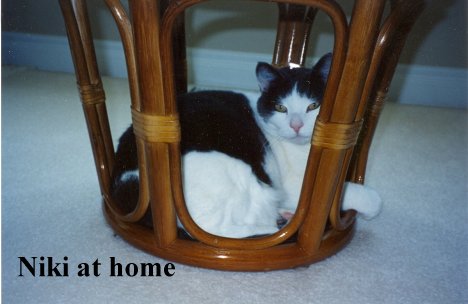
Couple years ago I visited my son in the South East of the United States, traveling by air from Calgary, Alberta Canada. At that time, he worked for a while in Atlanta, Georgia, away from Alabama where he was before. I took little Niki, a black and white cat, with me in a carrying sort of cat taxi. Made sure to also take his litter box with him in the bottom of the cat cage, some old rugs on top for comfort, and a small bowl with water. Advice is to always use a plastic carrier, not cardboard in case it gets soaked. Prior to leaving the house I had given Niki a relaxation pill (from the Vet) to make the flight less stressful. I am not sure where they put the pets on the flights, but assuming that it is a cold area. I was so sorry for the little guy, knowing cats do not like to go away from their home. Arriving Atlanta airport, my son picked me up and told me that he quit his job in Atlanta and was on his way back to Birmingham, Alabama. So we had to spend the night in a motel in Atlanta. They did not mind my cat, being he was in the big carrying cage and we had his litter box. He behaved very well that night. Everything worked out fine. Even during the drive by car back from Atlanta to Birmingham. At my son’s apartment in Birmingham there was a balcony to sit outside. We had bought some chicken wire to string around the top of the surround walls, so the cat could not get out. Other cats in the neighborhood came visiting of course, to check out who had moved in. But all went well, although arriving back in Calgary Niki was slightly disoriented and not too happy.
I like to share a little story I recently read in a magazine, by William Thomas* titled People Prefer Pets to Other People? No!.
A man wrote a letter to a small American motel he planned to stay at for a night: “I have stayed at your lovely motel many times in the past but now I have a dog. I was wondering if he too could stay at your motel. My dog is clean, well-groomed and well-behaved. I like to ask if you let him stay in our room as well.”
The motel owner’s reply: “I have been operating this motel for over 30 years. In all that time I have never had a dog steal towels, linens, silverware or paintings off the walls. I have never had to call the cops for removing dogs off my premises for drunken or disorderly behaviour. I have never had a dog take off without paying the bill. So, yes, indeed your dog is more than welcome to stay at my motel.” [story slightly abbreviated]
The Peruvian Paso or Peruvian Horse is a breed of light pleasure saddle horse known for its smooth ride. It is distinguished by a natural, four-beat, lateral gait called the paso llano. This breed is protected by the Peruvian government through Decree number 25919 of Peru enacted on November 28, 1992, and has been declared a Cultural Heritage of the Nation by the National Institute of Culture (INC).[1] Due to the isolation suffered for about 400 years and the selection made by their breeders, this breed is very particular in their body proportions and a side walk or “paso llano” that is characteristic. It is typical of the northern Peruvian regions of the country from which he originated [Wikipedia].
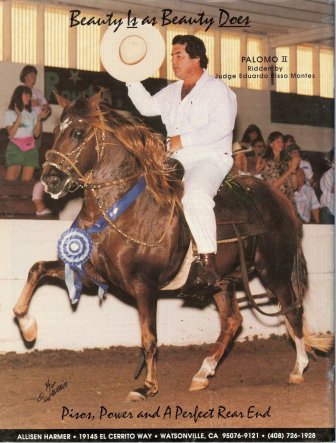
In 1998 I had acquired a registered Peruvian Paso mare called SIRENITA. Señorita Sirenita was a lovely little dark bay mare, small even for her breed who are smaller horses, very elegant with a nice smooth Paso Llano gait (a distinct inherited, andcompletely natural four beat lateral gait ), eager to please and with Brio (qualities of boldness, exuberance and astute focus in service to the rider). One says, “riding a Peruvian Paso with a glass of Champaign in one’s hand should not spill a drop of it.”
Sirenita when I bought her had been 4 years young only. Trained by a professional Peruvian trainer at the Ranch where she was foaled. I brought her to my Ranch in Alberta NW of Calgary in the Foothills of the Rockies, together with a companion mare, to keep her company. I rode Sirenita her in the forests (my 80-acre Ranch was surrounded by miles of Crown Land, lots of space) and the trails. She was easy to get along. 1999 we had her bred by one of the class stallions at her home Ranch, RDLF DON RODOLFO, also a dark bay stallion, bred as so many Peruvian Pasos in California Rancho de la Florecita.
Before Sirenita was due with a foal, I had brought the two mares to her home Ranch because with their hundred or so Peruvian Pasos they had the better foaling facilities. My beautiful little SIRENITA had a tiny little foal exactly on Mother’s Day, May 14, in the year 2000. And the other little miracle was that the foal – who was a colt – turned out to be sorrel in color, a beautiful golden bronze color, unlike his parents, who had both been dark in color.
That’s where the real story starts, with training a horse baby. After the night the baby was born I drove down to their ranch, sat in their stall – it was quite an emotional experience for me. I had horses for so many years, but never a foal. He was so little (her first) that he disappeared under her belly. Of course horses are very shy of humans, and when unknown they take flight of anything and anybody. However, it is important to start contact immediately with a tiny foal after they are born. It is part of the process of getting to know each other. In horse parlance this process is known as IMPRINTING. A learning process occurring soon after birth of a foal, the best and only opportunity to establish future behavior patterns in a horse towards people.
I spent each day inside the stall with the little guy and aided by his mom’s cooperation, to get acquainted, to touch eventually without frightening him. You need a lot of patience for accomplishing this. In four days I could touch him, then within one week put very carefully a tiny baby horse halter on – it was pink, for a little girl, but who cares. And within couple of weeks I was able to pick up his hind legs for some light hoof care. What a guy!
I include two videos of the colt’s progression, one an audio video, made by my son Marc at Sirenita’s home Ranch – me riding the little mare and Buzzy ‘buzzing’ around her. – = Created with Firefox 19 Apr 13/13 –
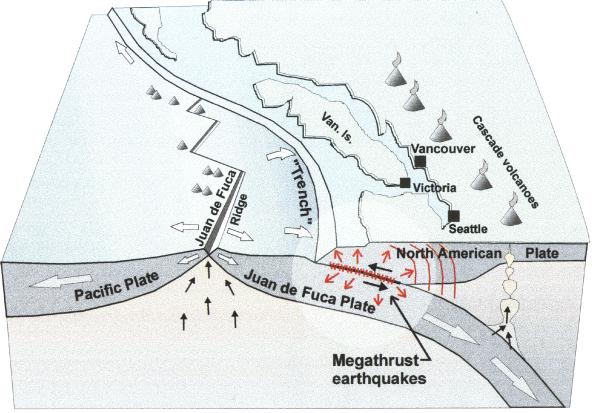
Victoria is also known as the ‘city of gardens’. In fact when I arrived in 2002, roses were still blooming in December. There are a number of spectacular gardens and parks. I put together a series of video slide shows of the Island, Victoria, Vancouver, and the town of Sidney at the northern tip of the Saanich peninsula where ferries take off for the mainland (about 5km north of Sidney). Lots of wildlife, best known for the resident pod of killer whales (orcas), large number of bald eagles & many more species. Vancouver Island is the largest Pacific Island east of New Zealand, near to 500km long at its longest point and 80km wide. Surrounded by over hundred islands and islets – the Gulf Islands. Across from Vancouver Island (by ferry) is Vancouver, Canada’s third largest city. Vancouver Island is basically a volcanic rock island. It is also situated along the Cascadia subduction zone, an earth quake zone from north of Vancouver Island to southern California. Canada’s most volatile fault line lies here deep under the ocean. More than 1000 seizeable earth quakes are recorded per year, due to active faults or breaks in the earth crust. The west coast of Canada is one of the few areas in the world where all three of of the most common plate movements take place, resulting in significant earthquake activity. My images embedded into my post also show some of the large ferries. I would say BC Ferries is the largest ferry operation on this planet with a fleet of around over 40 vessels. And these monsters operate exclusively between Vancouver Island and the West Coast main land [http://www.bcferries.com/onboard-experiences/fleet/]. Video’s :– (1) Victoria with Inner Harbour, Governor’s Mansion & Gardens. (2) Beacon Hill Park. (3) Sidney & Salt Spring Island. http://www.beautifulbc.net/index.asp?id=8

 LIFE's STORIES, ADVENTURES & TRAVELS