
Twenty seven years I spent in Alberta, north west of Calgary in the foothills of the Rocky Mountains as well as south west in the Kananaskis country [ http://www.kananaskis.com/ ]. Despite the cold winters, Alberta for me is still the most beautiful of Canada’s provinces. The landscape east of Calgary coming from Saskatchewan is rather flat and undulating, towards the mighty Rockies wide open skies and those wonderful mountains are a sight to behold. It is easy to imagine that the temperature during already cold winters is always at least ten degrees colder outside the cities. North west of Cochrane (which is the next town west from Calgary) I had snow up to five feet at times. The same when we lived almost ten years in Bragg Creek, a small hamlet south west of Calgary [ http://www.braggcreek.ca/ ], the snow was so high that I had to pull my old Dodge truck with my car over the acreage across the snow using my lariat, in order to be able to go to work in Calgary. Every morning up at 6 AM, driving down town to Calgary. When a blizzard hit the city, it had been impossible to drive home after work. I tried once, took me 3 hours slowly for twenty km. No heating in my car either.
When working up north on contracts, I needed to drive every weekend between Millarville [ http://en.wikipedia.org/wiki/Millarville ] from my large acreage to downtown Edmonton. Friday after work down and Sunday night back. Many times during that winter I was the only driver coming out of Edmonton and driving south. We called this – highway No. 2 – the ‘killer highway’ because of the many accidents occurring during iced up winter roads. I counted at times at least fifty vehicles upside down and inside out in the ditches. Driving slowly, I made it. My ranch near Millarville was steep uphill, a quarter of a mile to the house, walking and leaving the car in front of my gate. Once my front door was frozen, I had to break in else to face freezing to death.
How did we survive ? As the saying goes: “There is no such thing as a cold winter, only bad clothing.” We wore arctic clothing and heavily padded overalls – like worn in the oil fields. Long underwear of course and heavy gloves and high padded boots. I had been in Fort McMurray as well working temporary for Suncor oil company in 1987. In winter. [ http://www.suncor.com/default.aspx ]. Lucky for all of us contractors, it did not last long, as one of their buildings blew up and all contractors had to leave. Today, living by the Pacific Coast, and warmer climes, I could not take that cold anymore.
Latest Entries »
 Can they make you rich ? That’s a good one. The other day a friend asked me if it is beneficial or economically viable to have horses, not that I know what they intended to do with them. Unless you are a super rich Saudi Prince who can afford to buy expensive horses for racing or breeding, horses do not make you rich.
On the contrary. They cost a lot of money to keep: feed, stabling, exercise, and most of all veterinary care. A horse that is frightened can easily do himself in right there and then and in no time thousands of dollars are lost.
The horses I owned and worked with were all expensive registered horses. I started in Europe, The Netherlands, with sport horses. Then for many years in Alberta, Canada, I had registered Quarter Horses, one registered Paint filly and a set of pure bred Peruvians. My Quarter Horses, that I either raised and then trained, or acquired trained and needing lots of work, I also showed in Western shows in southern Alberta, Claresholm, or elsewhere. They were all cutting and reigning horses, out of Legends. In fact. some of the ancestry went back to stallions that easily got 100 thousand as stud fee. That was then.
The expenses for upkeep made me poor. As a single mother and working several jobs and professions in Alberta. For myself ? spending $25 for food a week, not for my horses, they were well-fed and taken care of. Lost my share in (fence run-in) accidents. Other costs also including expensive equipment, horse trailers, trucks, and miles of fencing I built myself. Sometime in winter, minus 30C or worse. Out in the cold – one winter it was minus 50C – getting up early in the morning, for hay and check the waterers, I wished I was dead.
Not to forget the many accidents and broken bones I acquired as a bonus. Doing a lot of the vet care myself. Have you ever seen a cowboy who is rich ? Must be kidding.
[More about my horses individually some other time.]
MAPLE LEAF ADVENTURE
on their beautiful schooner sailing vessel The Maple Leaf, truly a gem among sail boats [ http://en.wikipedia.org/wiki/Maple_Leaf_%28schooner%29 ].
In a south direction through the Johnston Strait. The entire north eastern area with its many little islands is within the Broughton Archipelago [ http://www.env.gov.bc.ca/bcparks/explore/parkpgs/broughton/ ], a rich fishing marine park visited by many large whales, such as the Humpback Whale, and the Orca (or Killer whale), as well as dolphins, sea lions, and of course there are also the bears, waiting for the salmon runs. And many species of sea birds, mostly Bonaparte Gulls . (Broughton Archipelago Park, B.C.’s largest marine park, consists of a collection of dozens of undeveloped islands and islets situated at the mouth of Knight Inlet on the west side of Queen Charlotte Strait near the north end of Vancouver Island).
October is usually the time of year when it does get cooler and there is more rain, especially up north on Vancouver Island [ http://www.hellobc.com/vancouver-island/popular-areas/north-island.aspx ]. Our adventure cruise started at Port McNeill, a small northern fishing community on Vancouver Island’s north eastern shore, Queen Charlotte Strait. [ http://portmcneillbc.com/ ] . Two ways to get there without driving: using the Greyhound Bus Service from Victoria, which makes multiple stop on the way and may take up to 12 hours to Port McNeill. Flying up there is the answer. Couple of hours (for me Victoria to Vancouver, Vancouver to Port Hardy). I was lucky meeting a lady whose sister lives in Port McNeill, offering me a ride to there. October 11th, 2 PM embarking from the Port McNeill Marina. Most of the time around that time of year lots of rain. Teaches me to bring 100% water proof clothing next time. October 12 our Marine Biologist Jackie Hildering [ http://themarinedetective.com/ ] joined us on board (from Telegraph Cove) enlightening us with many educational presentations, mainly around the impressive comeback of the Humpback Whale, and the importance of respecting all species in this precious marine environment. Large boats and small kayaks are not conducive to offering the respect that these animals deserve.
Telegraph Cove has an impressive little museum with large exhibits of skeletons of sea mammals and one huge skeleton of a fin whale, the second-largest species of whale, with a maximum length of about 75 feet. All these are baleen whales who collect food – for the most part tiny krill and fish – through their huge baleen plates inside their mouths, hard plastic instead of teeth, through which food is filtered. Whereas toothed whales use their teeth for feeding, this would include the killer whale (orca), also the dolphin, among the 65 species of toothed whales.
This tour has been very educational, but also with commercial undertones. In fact the entire commercial side of what is known as adventure cruises, whale watching tours in boats, kayaks or specially outfitted zodiacs is overrated, often destructive to the precious marine life. The Pacific Whale Watch Association specifies a required distance of 100 yards (not closer, standing still) near an animal – this is too close. [ http://pacificwhalewatchassociation.org/guidelines ]; US is 200 yards.
What is 200 or 100 yards in the presence of humans, noise, taking photos, disturbing mothers and baby animals likewise. There is too much pressure on those whales. Yet, it seems that the Humpback has made an encouraging comeback.
Altogether there were six days, five nights of sailing south from our starting point. Sailing south along the Johnston Strait, more rain, more wind, gale winds even. Around many small islands, making stops on some with our zodiacs. Fantastic large number of dolphins that followed out sail boat for hours. Several Orca in the distance, and the usual sea lion colonies on the rocks. Interesting outings onto surrounding islands to observe the salmon runs. There are many species of salmon. Also, disturbing sightings of many commercial fish farms, managed by Norwegians, and the pollution to our wild salmon populations as a result. No bears. (NOTE. Viewing bears better further up north.)
Disembarking at the Cameron Island Marina, Nanaimo, Eastern Vancouver Island. From there I took the Greyhound Bus back to Victoria.
Interesting eye opener this entire adventure in terms of what I learned about animals and people. My primary objective has been to learn more of the marine wild life and – if lucky enough – to actually get a glimpse. Couple of video’s follow.
When going on a trip meeting diverse people if often happens that the stories turn to guns. This being an ‘iffy’ subject, it is usually not wise to talk too much about my own gun stories in the presence of the ladies.
As long as I remember, following post-WWII, we were confronted by situations having to protect ourselves, not only because of the presence of American Army GI ‘s everywhere in Germany. Frankfurt – a hot place then – dangerous. I needed to spend one week a month on a post-grad IT course. Everybody had to carry some protection – be it only a little Walther UP1 tear gas pistol.**
[** Story about the tear gas pistol: In the 1970’s in Germany it happened that a very angry taxpayer went into the Federal Tax Department office, pulling out his tear gas pistol, shooting at close range into the tax inspector’s face, injuring his eyes. Law came into place, to make those guns illegal. Also, because owners of such devices modified them for shooting.]
Another gun story – [ Its ‘journey’ around the world started in The Netherlands. In the approx. 1960s. The little hand gun, a Browning caliber 7.65mm European model, here the .32 ACP [ http://en.wikipedia.org/wiki/.32_ACP ] belonged to my husband who spent years in the Indonesian war theater Koninklijke Marines Java/Indonesia long before I met him. That gun followed me around the world, ending up here. The RCMP got this gun 1980’s, it’s somewhere. ]
Years in Alberta will teach anybody in the country a bit about the long rifle. We all had them. Hunting moose and deer in winter, and shooting grouse in fall for Thanksgiving. Shotgun, hunting rifle, 22 and more. [That was all legal at that time, in conjunction with an FAC = Firearms Acquisition Certificate, and a wildlife license for hunting.] In between the periods of the Canadian Gun registry program [ http://www.rcmp-grc.gc.ca/cfp-pcaf/online_en-ligne/reg_enr-eng.htm ] . I still believe that the Province of Alberta brought down that (terribly expensive) gun registry program.
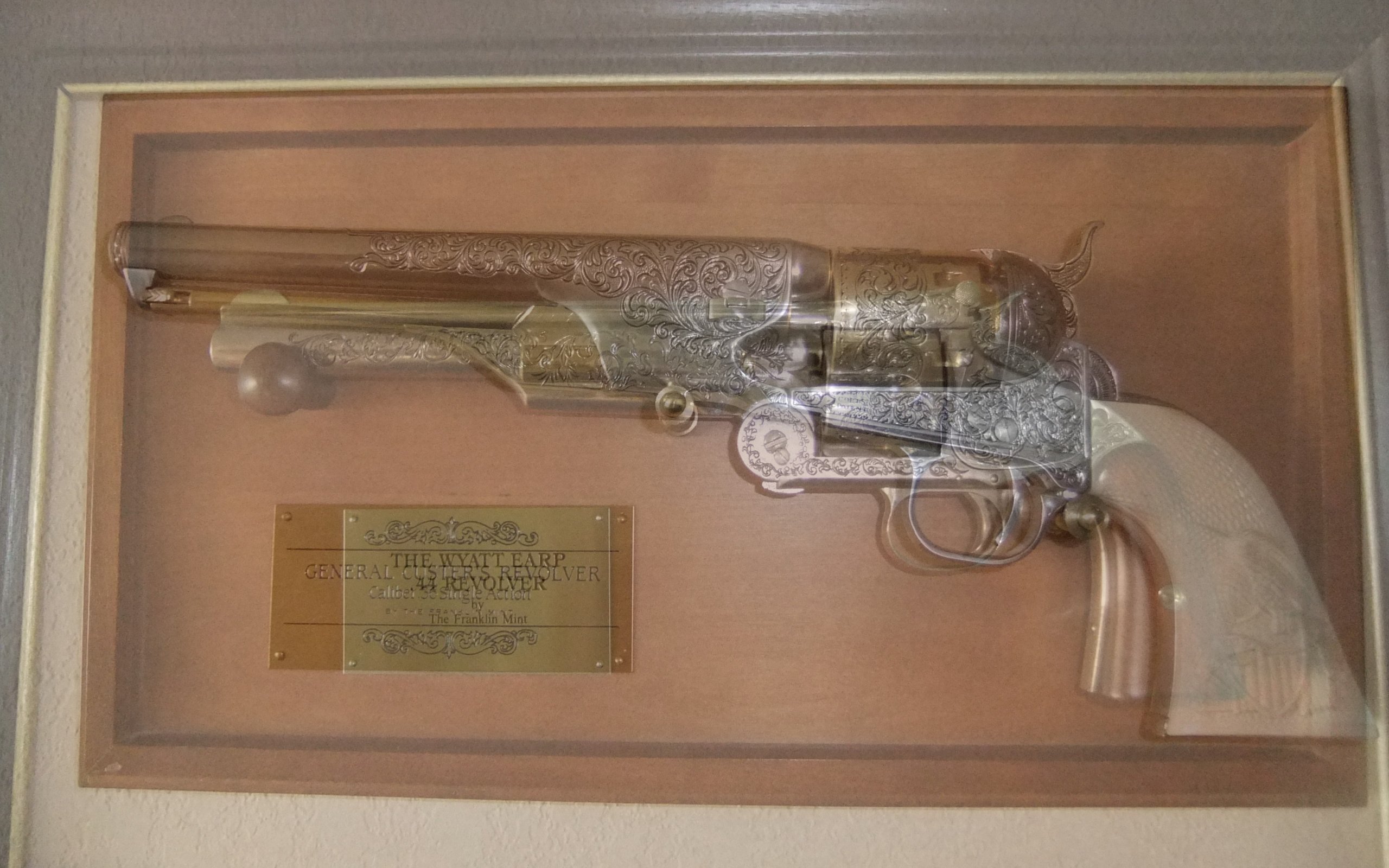
My long rifles from Alberta ending up on the coast here, and all legally sold to a gunsmith in the Highlands. Myself, am collecting antiques and collectors items now, wherever I travel. My favorites from the Franklin Mint Collectors Society: Exact re-creations of the Wyatt Earp .44 Smith & Wesson Revolver; and General Custer’s Colt .36 Model 1861 Navy Revolver. Both of these modified, so that they cannot chamber ammo.
Present regulations [ http://www.rcmp-grc.gc.ca/cfp-pcaf/form-formulaire/index-eng.htm ].
My recent visit to this year’s Greek Fest 2014 Victoria BC, Vancouver Island. There is an estimated 100 Greek families in Greater Victoria who keep the Greek culture and traditions alive. Of which, best of course, are their traditional dances and the wonderful food – authentic succulent roasted lamb (with rice and salad), souvlakis and the great many delicious Greek pastries like Baklava, Koulouria and more. Not to forget the original Greek Coffee brewed to old tradition like Turkish Coffee, using the brass briki (the pot) Greek coffee is a strong brew, served with foam on top and the grounds in the bottom of the cup. Although it can be made in a different pot, the traditional small pot is best because it allows the proper amount of foam , very tasty.
The day was hot and special attractions included the many Greek dance groups from Canada and Athens, Greece. I love the Greek music. Of interest were also all the old and original artifacts still in the possession of the Greek families, exhibited in the adjacent Heritage Centre.
Very enjoyable weekend and lots of sunshine. [I didn’t stay to the end because I was there by bicycle, around 12km ride one way and then back again to Victoria City.] My video clips show various popular and also widely travelled dance groups, including the ELKELAM Dance Group from Athens Greece, the Dionysos Greek Dancers from Edmonton and from Calgary, both Alberta, Canada, and Diaspora Greek Dancers from Vancouver.


Reality of WWII
[ http://ww2db.com/battle_spec.php?battle_id=55/Bombing-of-Hamburg-Dresden-and-Other-Cities-World-War-II-Database ]
My home town – was right close to Berlin, right smack in the path of the major bomb corridor between England and Berlin – destroyed to 90 %. I was two year old when Canada declared war on me (I take this personally). And I was seven years old when the war officially ended, but unofficially continued with bombings still going on in certain areas. Hah ! Now, were those the same people who after all that destruction pretended to have invented all sorts of ‘Anti War’ symbolism ? In their little war mongering minds they may have thought that (He, it is now seventy years ago) we forgot ?
A victim never forgets ! And when I am a hundred years old I will still remember. After all, two year old babies did not start WW2, nor did they march with rifles slung over and shoot (uselessly, I might add) at the flying bomber aircraft in the air.
Of course, the bombings still continue, even seventy, eighty or who knows hundred years after 1945 [ http://www.spiegel.de/international/germany/unexploded-wwii-bombs-pose-growing-threat-in-germany-a-859201.html ].
You can read into this whatever you want, published on the Web by historians, not by people who were actually right in the middle of those bombing raids – victims, little children. So, to all those who were inside those aircraft and dropping their loads onto civilians, do not come with stories of MAKE LOVE, NOT WAR.